
If you have heard "save three to six months of expenses" and felt your stomach drop, you are not failing at money. You are looking at a target that was never built for a tight budget, and feeling like it's impossible, so you've saved nothing. That's a completely understandable place to land. Let's throw that giant number out for now and start somewhere you can actually reach.
Here is the honest version of how to build an emergency fund when there is barely anything left at the end of the month: forget six months, aim for a tiny first goal, automate small amounts, and keep the money just far enough away that you won't spend it by accident. That's the whole plan. We'll take it one piece at a time.
First, the part no one says out loud
You are not behind because you're careless. You're in the same boat as a huge share of the country. Federal Reserve data has found that only a little over half of adults have savings to cover three months of expenses, and among the lowest earners the share is far smaller. A meaningful slice of adults could not cover a $400 emergency by any means at all. Our look at whether you could cover a $400 emergency digs into exactly what that data measures.
Read that again if you need to. Not having savings yet is not a character flaw. It's a math problem that millions of people are living with, and math problems have solutions.
Forget six months. Start with a number that feels almost too small.
Set your first emergency fund goal at $100, then $500, not six months of expenses. The CFPB, which is a federal agency with no product to sell you, says plainly that "even a small amount can provide some financial security" (CFPB, essential guide to building an emergency fund). They don't push a giant number. They tell you to pick a goal based on your own past surprise expenses.
So your first target isn't six months. It's $100. A hundred dollars saved is the difference between a flat tire being a stressful errand and a flat tire being a payday loan. Once $100 is sitting there, you aim for $500. After that, you can think bigger. But you climb the staircase one step at a time, and the first step is small on purpose.
Find $5 to $25 without "budgeting harder"
You don't have to white-knuckle your way to savings. The easier path is to find small money that's already moving through your account. The CFPB calls this cash-flow management: track what comes in and what goes out, then redirect a little. A few ways that work in real life:
- Pick one swap, not ten. One streaming service paused, or one fewer takeout order a week, and that money goes straight to savings.
- Turn on round-ups. Some bank and credit union accounts round purchases to the next dollar and stash the change. Just check that the tool is free, because fees vary.
- Shift a due date. If a bill hits right when your account is empty, ask the biller to move it. Smoothing your timing can free up a "surplus week" to save from.
As a starting rate, even $10 to $100 a month, or $25 a week, builds a real buffer over time. Saving roughly 2.5% to 5% of your income is a common, attainable first pace. These are starting points, not rules. Twenty-five dollars a week is $1,300 in a year. Start with five if five is what you've got.
Make it automatic so willpower isn't the plan
Set up a small automatic transfer to savings on payday so the money moves before you can feel it leave. Willpower is exhausting, and it runs out exactly when you're stressed. Automation doesn't get tired.
Schedule the transfer for the day your paycheck lands, even if it's just $10. One thing to watch: keep an eye on your balance so an auto-transfer doesn't accidentally trigger an overdraft fee. Set a low-balance alert or a calendar reminder. The CFPB recommends exactly this, automate but watch, so a tool meant to help you doesn't cost you a fee.
Use the windfalls you forgot about
The single biggest deposit many people see all year is a tax refund. When yours arrives, peel off a slice for your emergency fund before it disappears into everyday spending. The CFPB specifically names windfalls, refunds, rebates, and gift money, as one of the easiest ways to jump-start savings, because that money wasn't already spoken for.
You don't have to save all of it. Even a quarter of a refund can get you most of the way to that first $500. Decide the split before the money lands, because money that has a job already is much harder to fend off when it shows up.
Where to actually keep it
Keep your emergency fund in a separate, insured account that's a little out of reach, not in your everyday checking where it blends in. A dedicated account at a bank or credit union is the safest home, because deposits are insured up to $250,000 by the FDIC (banks) or the NCUA (credit unions). A high-yield savings account is a popular fit for this money: it's liquid, it's insured, and it earns more than a checking account (CFPB, guide to building an emergency fund).
I'm describing a category, not steering you to one bank. Rates on these accounts change all the time, so compare a few. The features that matter most are simple: separate from your spending money, insured, and easy to reach in a true emergency but not so easy you tap it on a Tuesday.
How to not raid it
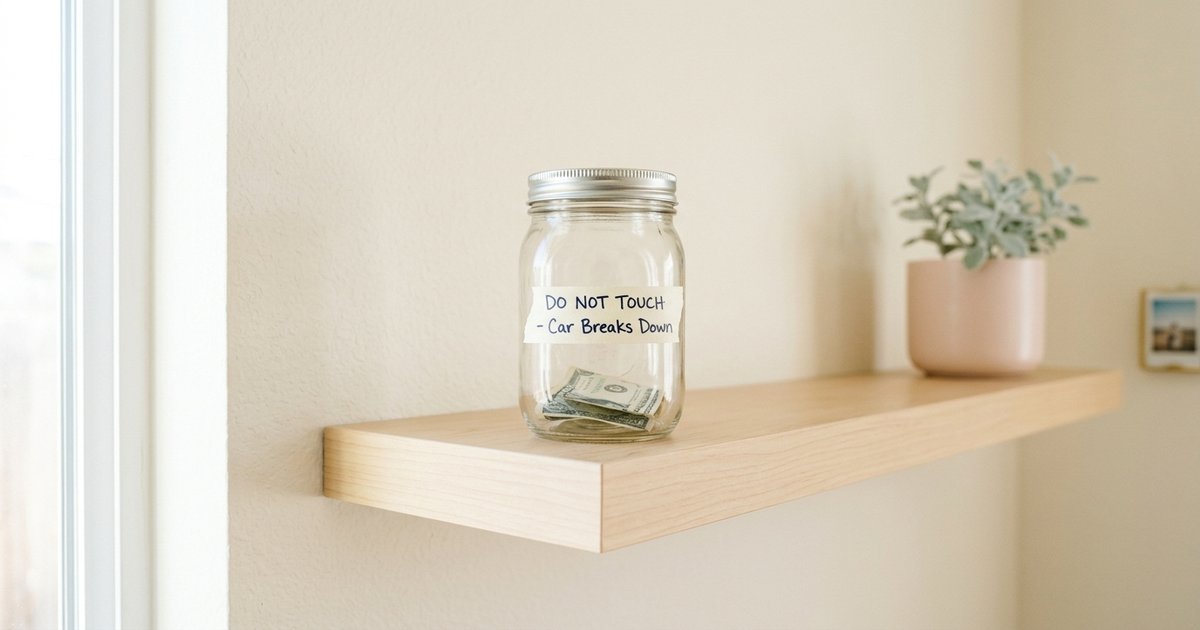
Give the account a name that makes you pause, something like "Do Not Touch" or "Car Breaks Down," and write down what actually counts as an emergency. When the account has a job and a name, dipping into it feels like breaking a promise to yourself instead of just moving money around.
A simple rule of thumb: an emergency is something urgent, necessary, and unexpected. A medical bill, a broken furnace, a car you need to get to work. A sale, a vacation, or a "treat yourself" moment is not an emergency, even on a hard week. Keeping that line clear is what turns a savings account into an actual safety net.
What this protects you from
Here is why even $500 matters so much. Without a buffer, the CFPB notes, people "may rely on credit cards or loans, which can lead to debt that's generally harder to pay off." A small fund is what stops a surprise expense from becoming a high-interest balance that follows you for years.
If your numbers are so tight that even $5 a week feels out of reach right now, that's worth a closer look, not a reason to give up. Running your income and expenses through our budget calculator can show you where the small money is hiding, and a flexible 50/30/20 budget gives the savings somewhere to live. And if a real emergency hits before your fund is ready, knowing how to borrow safely in an emergency keeps a hard month from turning into a debt trap. If you do need to compare options, you can see what loan options may be available with no obligation.
Frequently Asked Questions
How do I build an emergency fund if I have nothing saved and barely cover rent?
Start absurdly small. Aim for $100 first, then $500, and save through tiny automatic transfers, $5 to $25 at a time, on payday. The CFPB confirms even a small amount provides real financial security. The goal early on is momentum, not a six-month cushion.
How much should my first emergency fund goal be?
Make your first goal $100, then build toward $500. The CFPB recommends setting a personalized target based on your own past surprise expenses rather than a generic number. Six months of expenses can come much later.
Where is the best place to keep an emergency fund?
In a separate, insured account that's a little out of reach, such as a high-yield savings account at a bank or credit union. Deposits are insured up to $250,000 by the FDIC or NCUA, and keeping it separate from checking makes it less tempting to spend.
How do I stop dipping into my savings?
Name the account something that makes you pause, write down what truly counts as an emergency (urgent, necessary, and unexpected), and keep the money in a separate account from your everyday spending. A clear rule and a little distance go a long way.
What's a realistic amount to save each month on a low income?
Even $10 to $100 a month, or about $25 a week, builds a meaningful buffer over time, and roughly 2.5% to 5% of income is a common first pace. These are starting points, not rules. Save what you can, even if it's five dollars.

Need cash before payday?
Pick your amount and get matched with lenders in our network. It's free, secure, and there's no obligation.